

The Question Every Owner Eventually Faces
There is a number for every car. A repair bill that, when it lands on the service desk, changes the conversation from "go ahead and fix it" to "I need to think about this."
That number is different for every car and every owner. It is not printed in the handbook. It is not a fixed percentage. It is a threshold where the cost of keeping the car stops being sensible and starts being a decision you need to justify to yourself.
This article is about finding that threshold honestly — before emotion, habit, or wishful thinking makes the decision for you.
Cost vs Car Value: The Starting Point, Not the Whole Answer
The most common rule of thumb is: if the repair costs more than the car is worth, do not fix it. That is a useful starting point but a poor final answer.
A car's market value is what someone else would pay for it. That number has very little to do with what the car is worth to you as transport. A car worth £1,200 on Auto Trader that needs an £800 repair looks like a bad decision on paper. But if that £800 buys you two more years of reliable motoring in a car you know, and a replacement car you would trust costs £4,000, the repair is the cheaper option — regardless of what the old car is theoretically worth.
The market value matters more when you are thinking about selling. If you are planning to keep the car, the relevant comparison is the cost of the repair versus the cost of replacing the car with something equivalent and trustworthy. Those are often very different numbers.
That said, market value is not irrelevant. It sets a rough context. A repair that is 50% of the car's value deserves proper thought. A repair that is 100% or more of the car's value needs a very strong case to justify. And a repair that is 150% of the car's value is almost always the wrong decision unless the car has sentimental value that you are consciously choosing to pay for.
Cost vs Expected Remaining Life
The more useful calculation is repair cost against the car's expected remaining life — not its past value.
If the car is fundamentally sound and the repair resets the clock on a major component, the repair may be worth far more than the car's market value suggests. A £700 cambelt and water pump replacement on a car worth £1,500 is a sensible investment if the car is otherwise healthy and you plan to keep it for another three years. That is £233 a year for continued transport. You cannot lease a car for £233 a month, let alone a year.
If the same £700 is spent on a car that has multiple other problems stacking up — an MOT due with known corrosion issues, a clutch that is starting to slip, an engine using oil — the expected remaining life is short. The £700 is not buying you three years. It might not even buy you six months. That is when the repair becomes too high, not because of the number itself, but because of what it fails to deliver in return.
The question to ask is: "If I spend this money, what am I reasonably buying in terms of future trouble-free miles?" If the answer is vague or worryingly short, the bill is too high regardless of the amount.
One-Off Repair vs Pattern of Decline
A single large repair on an otherwise reliable car is a very different situation from the latest in a long sequence of bills.
Every older car will eventually need something expensive. A clutch. A cambelt. A set of brakes all round. A DPF. These are predictable wear items. One large bill does not mean the car is falling apart. It means a component with a known service life has reached the end of that life. Fix it and the clock resets.
The danger sign is a pattern. When the repair bills start arriving closer together, or when each MOT brings a longer failure sheet than the last, the car is in decline. A £400 bill in March, a £300 bill in July, a £500 MOT failure in October, and now a £600 clutch in January. Individually, none of those are terminal. Together, they tell a story. The car is costing more to keep on the road than it is worth in the service it provides.
Track your spending. If the car has cost more in repairs over the last 12 months than its market value, and the pattern is accelerating rather than stabilising, the next bill is probably too high — not because of its size, but because of what it represents. It is not an isolated repair. It is the continuation of a trend.
Emotional Ownership Traps
The hardest part of this decision is not the maths. It is the attachment.
The "I've spent so much already" trap. You have put £1,200 into the car over the last year. Now it needs another £500. The instinct is to spend the £500 because walking away feels like wasting the £1,200 you have already spent. But the £1,200 is gone regardless. The only question that matters is whether spending £500 more is the right decision going forward. Do not throw good money after bad because the bad money is already spent.
The "better the devil you know" trap. You know your car. You know its history, its noises, its quirks. A replacement is an unknown, and unknowns feel risky. This instinct is partly correct — a known car with known faults is sometimes better than an unknown car with hidden ones. But it can also keep you trapped in a car that is quietly deteriorating, costing you more each year than a replacement would. Be honest about whether you are keeping the car because it is genuinely the best option, or because change feels uncomfortable.
The "it is almost a classic" trap. It is not a classic. It is a ten-year-old diesel hatchback. Unless the car has genuine collector interest, age alone does not make it worth preserving. Spending beyond the car's rational value because you have convinced yourself it will be worth something one day is almost always a losing bet on an everyday car.
The "I do not want car payments" trap. Avoiding finance is sensible. But if you are spending £1,500 a year keeping an old car on the road because a replacement on finance would cost £200 a month, you are spending £125 a month on repairs. That is not automatically wrong — but you are not saving as much as you think. At some point, the reliability and predictability of a newer car may be worth the monthly cost. The calculation is repair spend versus replacement cost, not repair spend versus zero.
Rational Thresholds That Help You Decide
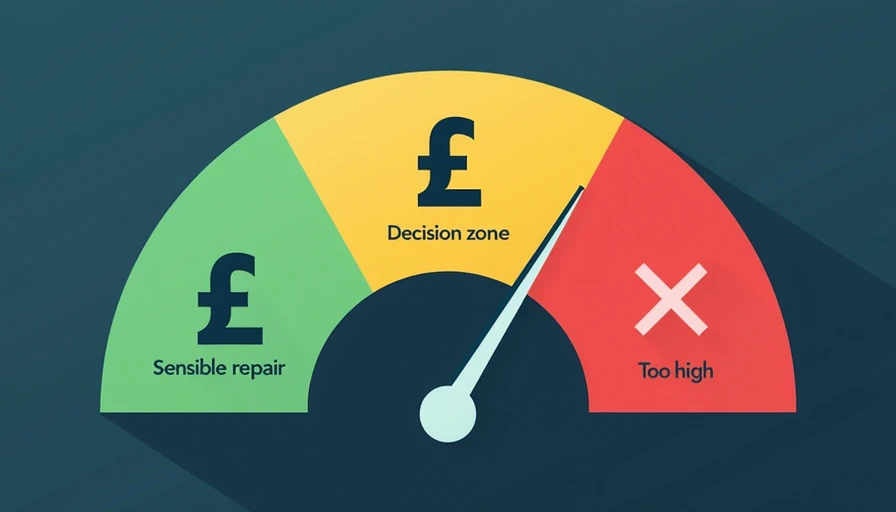
These are not rigid rules, but they are honest guidelines that work for most everyday UK drivers.
The 50% rule. If a single repair costs more than 50% of the car's market value, stop and do the full assessment. Ask about the car's overall condition. Consider what else is likely to need doing. This is the point where the decision deserves proper thought, not automatic approval.
The 100% line. If a single repair equals or exceeds the car's market value, the case for fixing it needs to be strong and specific. The car must be otherwise excellent, with a known history, and you must have a clear reason to believe it will deliver at least two more years of reliable service. If any of those conditions are missing, the repair is probably too high.
The 12-month total test. Add up everything you have spent on repairs and maintenance — not routine servicing, but actual repairs — over the last 12 months. If that total exceeds the car's current market value, and you can see more bills coming, the car has crossed into uneconomical territory. One more large bill should probably be the last.
The "replace it honestly" test. Search online for a car you would actually buy as a replacement, at a price you can actually afford. If what you find is materially better — newer, lower mileage, better history, genuinely more reliable — than what you would have after the repair, replacing is the smarter choice. If what you find is no better than what you already have, fixing makes sense.
How to Judge Fairly
When a large bill arrives, do these things before making the decision.
Get a second opinion on larger items. A different garage may quote differently or suggest a different approach. This is normal and sensible. You are not being disloyal to your usual garage. You are making an informed decision about a significant cost.
Ask about the car's overall condition while the garage has it in the workshop. A technician who has just spent time under the car is in the best position to tell you honestly what else they can see. Listen carefully to the answer. "It is fine" is very different from "well, the brakes will need doing soon, and I noticed the exhaust is starting to go."
Separate safety items from convenience items. A brake repair that keeps the car roadworthy and safe is different from a cosmetic repair that makes the car look better. If the bill includes both, ask for the safety items to be priced separately. You may choose to do only what is essential and accept the rest.
Be honest about your own financial position. If the repair would put you into debt or deplete savings you cannot afford to lose, the decision is not just about the car. It is about your wider financial health. A car repair should not come at the expense of rent, bills, or essential living costs. If it does, the repair is too high regardless of what makes sense for the car.
Bottom Line
A repair bill is too high when the cost will not buy you enough future use to justify it — not when it exceeds an arbitrary percentage of the car's value. A £600 repair on a £1,000 car that buys two more years of reliable motoring is a good decision. A £300 repair on a £3,000 car that has been breaking down every other month is not. Judge the repair against the car's real condition, its expected remaining life, and the honest cost of replacing it. And do not let attachment or past spending make a decision that the numbers and the car's condition are telling you is wrong.
Fix the problem, not the panic.