


You Do Not Need to Know Cars. You Need to Know What to Say.
Most drivers are not mechanics. That is fine. You do not need technical knowledge to have a productive conversation with a garage. What you need is the right information, the right questions, and the confidence to ask them.
Garages are not inherently dishonest. Most are run by decent people doing a skilled job. But the service desk is a place where the balance of information is uneven. The garage knows more than you do. That gap can work against you — not always through deliberate dishonesty, but through poor communication, assumptions, and the fact that you do not know what to ask.
Closing that gap does not require a mechanical qualification. It requires preparation. The driver who walks in with clear information and the right questions gets better service, clearer answers, and a fairer price. The driver who walks in and says "it is making a noise, just fix it" is handing over their wallet and hoping for the best.
What Details to Bring Before You Arrive
The single most valuable thing you can bring to a garage is a clear description of the problem. Write it down before you call or visit. You will forget details at the desk. Everyone does.
Here is what a technician actually needs to know:
What the symptom is. A noise, a vibration, a warning light, a loss of power, a fluid leak, a smell. Be specific. "A metallic rattling from the front" is better than "a noise."
Where it seems to be coming from. Front, rear, left, right, engine bay, underneath. Point to where you think it is. Even if you are wrong, it gives the technician a starting point.
When it happens. Cold start, warm engine, at speed, when braking, when turning, when accelerating, when idling, all the time. This is often the most useful piece of information you can give.
How long it has been happening. Started last week, been there for months, noticed it after a long journey. If it is getting worse, say so.
Any patterns. Only on wet days, only after motorway driving, only when the fuel tank is below a quarter, only with the air conditioning on. Patterns are diagnostic gold.
If a warning light is on, note whether it is solid or flashing, amber or red. Take a photo of it. Do not clear it yourself before the garage sees it.
The driver who arrives and says "there is a high-pitched squeal from the front passenger side, only when I brake lightly at low speeds, started about two weeks ago and is getting a bit louder" has given the technician a clear head start. The driver who says "the brakes are making a noise" has given them nothing to work with. Both will get a brake inspection. The first driver will get a more focused one.
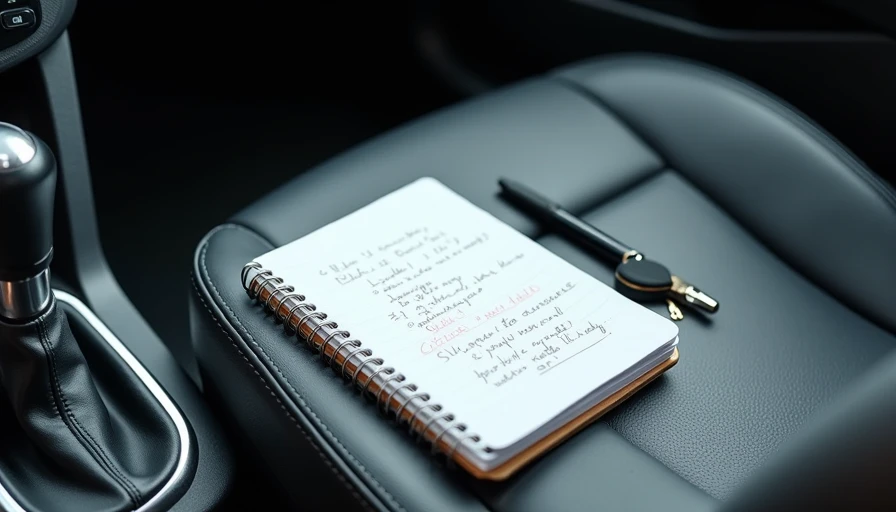
How to Describe a Symptom Properly
You do not need technical vocabulary. You need observation. Here are some useful plain-English descriptions for common problems.
Noises: Squeal, rattle, clunk, grind, hum, hiss, knock, whine. Each points in a different direction. "A clunk when I go over speed bumps" is not the same as "a hum that gets louder at motorway speed." The words matter.
Vibrations: Through the steering wheel, through the seat, through the brake pedal, at a specific speed. A vibration at 60-70 mph that disappears above or below that range is a different set of suspects from a vibration when braking.
Driving behaviour: Hesitation when pulling away, surging at steady speed, pulling to one side, steering feeling heavier than usual, brake pedal feeling soft or travelling further than it used to. These are all specific symptoms that point to specific systems.
Fluids: Colour and location. A clear water-like fluid under the car on a hot day might just be air conditioning condensation — harmless. A brown or black oily patch is engine oil. A red or pink fluid is usually transmission fluid or coolant. A green or blue fluid is coolant. Knowing the colour narrows the search.
If you are unsure about any of this, just describe what you experienced in your own words. The technician will translate. The important thing is that you make the observations and share them. Do not filter or self-diagnose. "I thought it was probably nothing so I did not mention it" has delayed more repairs than any other sentence.
What Questions to Ask
When the garage calls with findings, you do not have to simply accept the quote and say yes. You are allowed to ask questions. Here are the ones that protect you.
"Is this urgent, or can it wait?"
This is the most important question. A good garage will distinguish between "must do now for safety," "should do soon before it gets worse," and "advisory — keep an eye on it." If everything they mention is urgent, be sceptical. Genuine urgent items are rare. Most repair recommendations are "should do soon."
"What exactly is wrong, and how did you confirm it?"
A garage that has diagnosed a fault properly can explain it. They will tell you what they found, what test confirmed it, and why the repair is needed. A garage that is guessing will be vague. Listen for evidence, not assumptions. "The technician found excessive play in the offside track rod end during the inspection" is evidence. "We think it might be the track rod end" is a guess.
"Can you show me?"
Many garages now take photos or videos of faults. A corroded brake line, a split CV boot, a leaking shock absorber, a worn brake pad next to a new one — these are visual items. A garage that can show you the problem is a garage that is confident in its findings. If they refuse or make excuses, ask yourself why.
"What happens if I leave this for now?"
Some faults are safe to monitor. Others are not. A worn brake pad is safe to monitor until it reaches the wear indicator. A corroded brake line is not safe to ignore — it can fail suddenly. A garage should be able to tell you the consequence of deferring the repair. If the consequence sounds vague or minimal, you may have time. If the consequence is "the brake line could rupture and you could lose braking," do not defer.
"Is this the full price, including VAT and labour, with no extras?"
Ask for the total price in writing. Some garages quote parts and labour but exclude VAT until the invoice arrives. This is technically legal but poor practice. A decent garage gives you the price you will actually pay.
What to Request in Writing
Verbal quotes are easy to misunderstand and easy to dispute. Get the important things on paper or in an email.
A written estimate before work begins. This should include: the fault identified, the repair recommended, the parts required, the labour hours and rate, and the total price including VAT. Most garages will provide this as standard. If one refuses, take the car elsewhere.
Authorisation limits. Tell the garage: "Please call me for authorisation if the cost is going to exceed this estimate by more than 10%." This prevents the phone call where the garage says they found something else and have already done the work. Set the limit in advance.
Old parts returned. You have the right to ask for your old parts back. This does not apply to parts exchanged under a surcharge scheme — like a starter motor or alternator where the old unit is sent back for remanufacturing — but for most other parts, you can ask to see what was removed. This is not about distrust. It is about verifying that the work was actually done. A garage that refuses to return old parts without a valid reason is a red flag.
How to React to Vague Estimates
Vague estimates are a warning sign. "It will probably be around three or four hundred" is not a quote. It is a range wide enough to fit a surprise into.
When you receive a vague estimate, respond with specific questions: "Can you give me a written breakdown of parts and labour so I can see where the cost is going?" and "What would change the price from £300 to £400?" A garage that can answer these is being professional. A garage that gets defensive is not.
If the garage will not commit to a firm price, ask for a not-to-exceed figure. This sets a cap. They can spend less, but they cannot spend more without calling you. Most garages will agree to this. It protects both sides.
When to Get a Second Opinion
You would get a second opinion on a medical diagnosis. Do the same with a major car repair.
A second opinion is sensible when:
The repair is expensive and you have never used this garage before
The diagnosis does not make sense when explained to you
The garage is pressuring you to decide immediately
You have a gut feeling that something is not right. Trust that feeling.
A good garage will not be offended by you seeking a second opinion. They will tell you to take your time. A garage that pressures you, tells you the car is dangerous to drive elsewhere, or dismisses the idea of a second opinion is a garage to walk away from.
Getting a second opinion is not disloyal. It is sensible. You are spending your money. You have the right to be confident it is being spent on the right repair.
The Phrases That Show You Are Paying Attention
You do not need to act like an expert. You just need to show that you are engaged and informed. A few simple phrases change the dynamic at the service desk.
"Can you talk me through what the technician found?"
"Is this something I need to sort today, or can it wait until the next service?"
"What is the consequence if I leave this for now?"
"Can you put that in writing for me before you start the work?"
"Can I see the old parts when you are done?"
These are not aggressive questions. They are the questions of a customer who takes their car and their money seriously. A good garage welcomes them. A bad garage dreads them. The response you get tells you everything you need to know about who you are dealing with.
Bottom Line
You do not need a mechanical qualification to talk to a garage effectively. You need preparation, clear observations, and the confidence to ask straightforward questions. Bring the details. Describe what you experienced. Ask what is urgent and what is not. Get the quote in writing. If the answers do not make sense, ask again or go elsewhere. The garage that welcomes your questions is the garage worth keeping.
Fix the problem, not the panic.